
Payments
The DMCCA Subscription Legislation Now Lands in January 2027
The DMCCA subscription rules now apply from January 2027. What UK recurring billing businesses need to change across sign-up, reminders and cancellation.
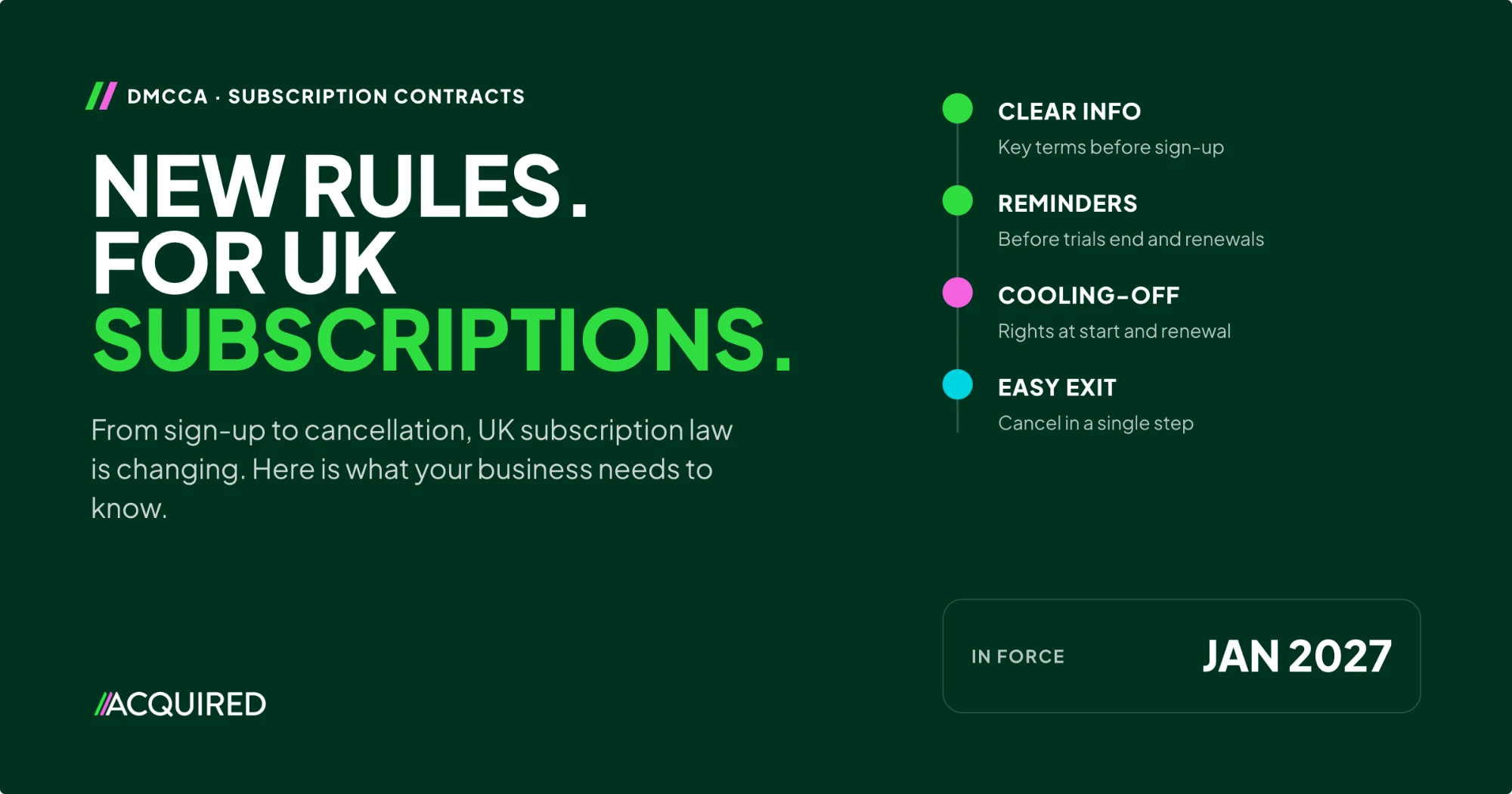
If you bill UK consumers on a recurring basis, a new set of rules is being introduced to protect consumers. Here’s what’s changing and how it affects your billing and payment journeys.
The subscription contracts regime under the Digital Markets, Competition and Consumers Act 2024 (DMCCA) was expected in spring 2027, but Prime Minister Andy Burnham has brought the start date forward to January 2027.
That leaves under five months before the rules apply.
What the regime is for
The DMCCA is the UK’s overhaul of consumer protection law. Its subscription chapter targets subscription traps, where consumers sign up through a free trial or discounted offer with inadequate disclosure, then find the contract hard to leave or quietly renewed at a higher price.
The market is large enough to make that a policy priority. UK consumers spend around £26 billion a year across roughly 155 million active subscriptions. The government estimates 9.7 million of those are unwanted, costing consumers £1.6 billion a year at about £14 a month each (government figures published alongside the 9 August 2026 announcement).
The intent isn’t to make subscriptions harder to sell — it’s to make the terms visible at the point of sale, and make leaving as easy as joining.
The timeline moved on August 9th
Prime Minister Andy Burnham announced the acceleration on 9 August 2026 as part of a series of cost-of-living “everyday fixes”, saying people are “sick and tired of rip-off discounts and subscription traps” (BBC News, 9 August 2026).
The regime’s launch date had been delayed twice before, from spring 2026 to autumn 2026 and then to spring 2027. This time it’s moved forward as the new government cracks down on the cost-of-living challenge.
What UK consumers will be entitled to
The regime gives consumers four protections, which subscription businesses must provide.
1. Clear information before they commit.
Consumers should be able to see what they’re signing up to at the point they sign up.
- Key pre-contract information including price, contract length, total cost and cancellation terms has to be presented as close to the point of contracting as practicable
- It cannot be buried in general terms and conditions or left behind a link
- Applied to full-price sign-ups, discounted offers and free trials alike
2. Advance notice before they’re charged.
Consumers should never be surprised by payment after a free trial, a renewal or a step up in price.
- A reminder roughly every six months for ongoing subscriptions
- A reminder before a free or discounted trial converts to a paid contract
- A second, earlier reminder before anything renewing beyond 12 months
3. 14-day windows to change their mind.
Consumers should get a proper cooling-off period, not just at sign-up but at the points afterwards where they may not have actively chosen to keep paying.
- Immediately after they enter the contract
- After a free or discounted trial converts to a paid contract, or a 12-month-plus contract auto-renews
- Cancelling within either window entitles them to a proportionate refund
The one to watch on revenue recognition
Revenue currently treated as banked becomes cancellable for a fortnight after every long-cycle renewal.
4. Cancellation flows as easy as sign-up.
Consumers should be able to cancel without being made to work for it.
- No unnecessary hurdles or multi-step retention flows
- Online cancellation if they signed up online
- Mandatory phone calls to cancel are the obvious exposure here
What getting it wrong will cost
The CMA holds direct enforcement powers, so it can investigate and fine without going to court first. A consumer protection breach carries a maximum penalty of 10% of global annual turnover, or £300,000, whichever is greater.
Note that it’s global turnover rather than UK revenue, so international groups selling into the UK carry larger exposures.
Who is in scope
Any contract between a trader and a consumer for an automatically recurring supply of goods, services or digital content, whether fixed term or indefinite. It applies to any trader selling to UK consumers, wherever they are established.
Out of scope: B2B, financial services, utilities, Ofcom-regulated communications, certain healthcare, certain gambling and the National Lottery, residential accommodation and rental, package travel, childcare and school-age education, and Gift Aid and certain charitable, cultural and heritage memberships.
The CMA has already shown its hand, just not on subscriptions yet
Drip pricing sits under a different part of the DMCCA to the subscription contracts regime, and it’s already in force — since 6 April 2025, banning mandatory charges from being added after the headline price is shown. It has nothing to do with subscriptions directly, but what it does show is how the CMA behaves.
In April 2026 the CMA fined AA Driving School and BSM £4.2 million, reduced from £7 million for early settlement, and ordered repayment of more than £760,000 to over 80,000 learner drivers. The breach was a mandatory £3 booking fee added later in the checkout journey (CMA, 15 April 2026).
A £3 fee produced a £4.2 million penalty. We read that as the clearest signal available on how the CMA is likely to approach the subscription legislation from January.
What next
If you’re reviewing your subscription billing and payment journeys ahead of the January changes, get in touch. Acquired provides the payments and billing technology behind flexible checkout, billing communications and cancellation flows.
How much of that can your current setup do today?
This article is for general information only and does not constitute legal or regulatory advice. Businesses should seek their own professional advice on their obligations under the DMCCA.