
Payments
Commercial VRPs Just Got Bigger: What UKPI's Wave 1a Unlocks
Commercial VRPs now cover personal loans, motor finance, housing, rail ticket retailers and charity platforms. Here's what UKPI's Wave 1a means for you.
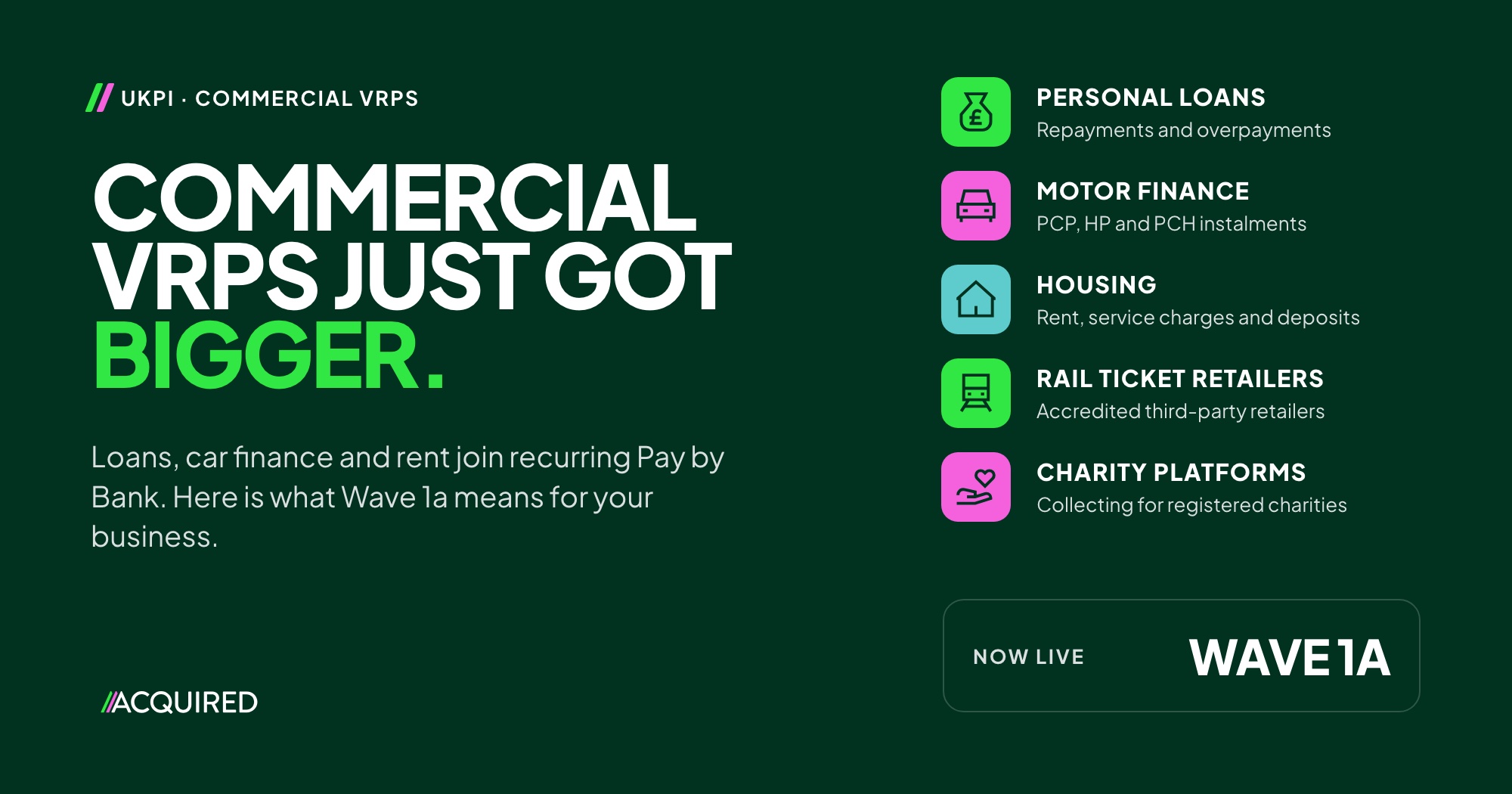
Five New Use Cases for Commercial VRPs
Commercial variable recurring payments (cVRPs) can now be used for five more use cases: personal loan repayments, motor finance, housing payments, rail ticket retailers and charity platforms. This is Wave 1a, the first expansion of the UK Payments Initiative (UKPI) scheme that launched in June.
When commercial VRPs went live on 2 June 2026, it opened up recurring Pay by Bank to utilities, government, charities and financial services. It was a strong start, but some of the biggest bills in a household budget were still missing.
Not any more. Wave 1a brings loan repayments, car finance and rent into scope. If your business collects any of these, the way you take payments now has more options.
A Quick Recap: What Are Commercial VRPs?
A commercial VRP lets a business collect payments straight from a customer’s bank account, within limits the customer sets. The customer approves a mandate once in their banking app, choosing a maximum amount, a frequency and an end date. After that, payments flow automatically: no card details, no re-authorising every time.
The customer stays in control and can view or cancel the mandate in their banking app whenever they like. At Acquired, we call this recurring Pay by Bank.
The scheme is run by UKPI, an industry-owned company backed by banks and fintechs. One rulebook, one commercial model, no bank-by-bank negotiations.
Wave 1 vs Wave 1a: What Has Changed?
Wave 1 covered lower-risk, regulated sectors: utilities and telecoms, train companies, regulated financial services, e-money, government and registered charities. Wave 1a goes further and three of its five new use cases cover some of the biggest regular payments people make.
Personal loan repayments
FCA-regulated lenders can now collect repayments and overpayments on regulated personal loans by cVRP, paid to the lender or its appointed loan servicer.
Borrowers who pay early, amounts that shift, payments that fail when a card expires: cVRP handles all three. One mandate flexes with the loan, within limits the borrower has agreed and there is no card to expire.
Motor finance
FCA-regulated motor finance providers can collect monthly instalments on personal contract purchase (PCP), hire purchase (HP), personal contract hire (PCH) and other regulated agreements.
Car finance runs for years and cards rarely last that long. A cVRP mandate sits with the customer’s bank account, so there’s no expiring card to interrupt payments and the customer can always see exactly who they are paying.
Housing payments
Rent, service charges, ground rent and tenancy deposits can now be collected by cVRP. That covers registered social housing providers and housing associations, plus letting and managing agents who belong to a government-approved redress scheme.
Rent is one of the biggest monthly bills for most households. With cVRP, tenants approve once in their banking app and stay in control, while housing providers can collect the right amount when it’s due, even when charges change.
Also new in Wave 1a
- Rail ticket retailers. Accredited third-party retailers can now offer cVRP, not just train companies.
- Charity platforms. Fundraising and donation platforms can collect on behalf of registered charities.
Each use case has its own eligibility conditions, so it’s worth checking exactly where your business fits.
Why Wave 1a Matters for Merchants
Cards and Direct Debit have powered recurring billing for decades, but both come with friction. Cards expire, get reissued and attract chargebacks. Direct Debit failures often surface days after the fact. cVRP tackles both:
- Fewer failed payments. No card expiry dates or reissued cards to break your collections.
- Flexible amounts. Collect what’s actually due, within the customer’s limits, without asking them to re-approve.
- Faster settlement. Payments run over Faster Payments, so money usually lands in hours, not days.
- Secure authentication. Every mandate is authenticated in the customer’s own banking app.
- Customers in control. Clear limits and easy cancellation in their banking app build trust from day one.
Acquired’s Role
As a founding shareholder of UKPI, Acquired has been building for commercial VRPs since day one. The sectors we serve, from lending to charities, sit right at the heart of Wave 1a and the addition of housing and motor finance payments opens the door to new markets for recurring Pay by Bank. Our platform brings cards, Direct Debit and Pay by Bank together, all in a single payment integration.
Looking Ahead
Wave 1a won’t be the last expansion. Subscriptions and general e-commerce are expected in a future wave and businesses that get cVRP into their payment mix now will be ready to move fast when it lands.
Wave 1a turns commercial VRPs from a promising start into a serious option for lenders, motor finance providers, housing businesses and charity platforms. If that’s you, now is the time to look at how recurring Pay by Bank fits alongside your existing collections.